
Three months to go: start preparing for GSB 2026

The countdown has begun. In just three months, communities across the Southern Hemisphere will come together for the Great Southern BioBlitz 2026 (GSB 2026).
The observation period will run from 27–30 November 2026, followed by an upload and identification period ending on 14 December 2026.
Preparations are already well underway. At the time of writing, 84 local and regional projects across 19 countries and territories have registered and joined the GSB 2026 global umbrella project. More projects are continuing to join, extending the event’s reach across Africa, Australia, Oceania and South America.
Building on the success of GSB 2025
Last year’s event demonstrated the extraordinary contribution that thousands of individual observers can make when their efforts are brought together.
During GSB 2025:
282,261 observations were contributed
37,550 unique taxa were documented
9,993 observers participated
These results continued six years of strong growth. Since the first GSB in 2020, annual observations have increased from 70,959 to more than 282,000, while participation has grown from 2,512 to almost 10,000 observers.
Behind these numbers are thousands of records of plants, animals, fungi and other organisms, from familiar species encountered in urban parks to rare, cryptic and geographically restricted species.
Together, these observations provide an increasingly valuable snapshot of Southern Hemisphere biodiversity. They can support biodiversity research, conservation planning and environmental monitoring while helping communities learn more about the natural world around them.
GSB 2026 is taking shape
The growing GSB 2026 network already includes projects across:
Africa: Angola, Botswana, Eswatini, Gabon, Kenya, Madagascar, Mozambique, South Africa, Tanzania, Zambia and Zimbabwe
Oceania: New Caledonia & Australia
South America: Argentina, Bolivia, Brazil, Colombia and Ecuador
Local projects range from large metropolitan areas such as Greater Sydney, Brisbane, Greater Melbourne, São Paulo, Manaus, Johannesburg and Quito to regional and remote landscapes including the Great Barrier Reef, Zanzibar Archipelago, Madagascar, the KZN Drakensberg, the Top End and the Exmouth–Carnarvon–Ashburton region.
You can explore the complete and continually updated list through the:
Now is the time to start preparing
Three months may sound like plenty of time, but the event will be here before we know it. Organisers and participants can begin preparing now by:
Joining their local GSB 2026 project
Inviting schools, naturalist groups, community organisations and friends to participate
Planning guided walks, surveys and community events
Identifying accessible locations and under-recorded habitats to explore
Practising making and uploading observations through iNaturalist
Learning about local species and identification resources
Recruiting experienced identifiers to support participants
Promoting local projects through newsletters, websites and social media
Early preparation helps local projects reach more people, cover a wider range of habitats and make the event enjoyable for both new and experienced participants.
Is your region represented?
If you cannot find a project covering your region, there is still time to become involved as a local organiser.
Returning organisers:https://bit.ly/GSB_Returning_Organisers
New organisers:https://bit.ly/New_GSB_Organisers
New projects are being established regularly, so continue checking the global umbrella project for the latest additions.
Introducing the GSB 2026 banner
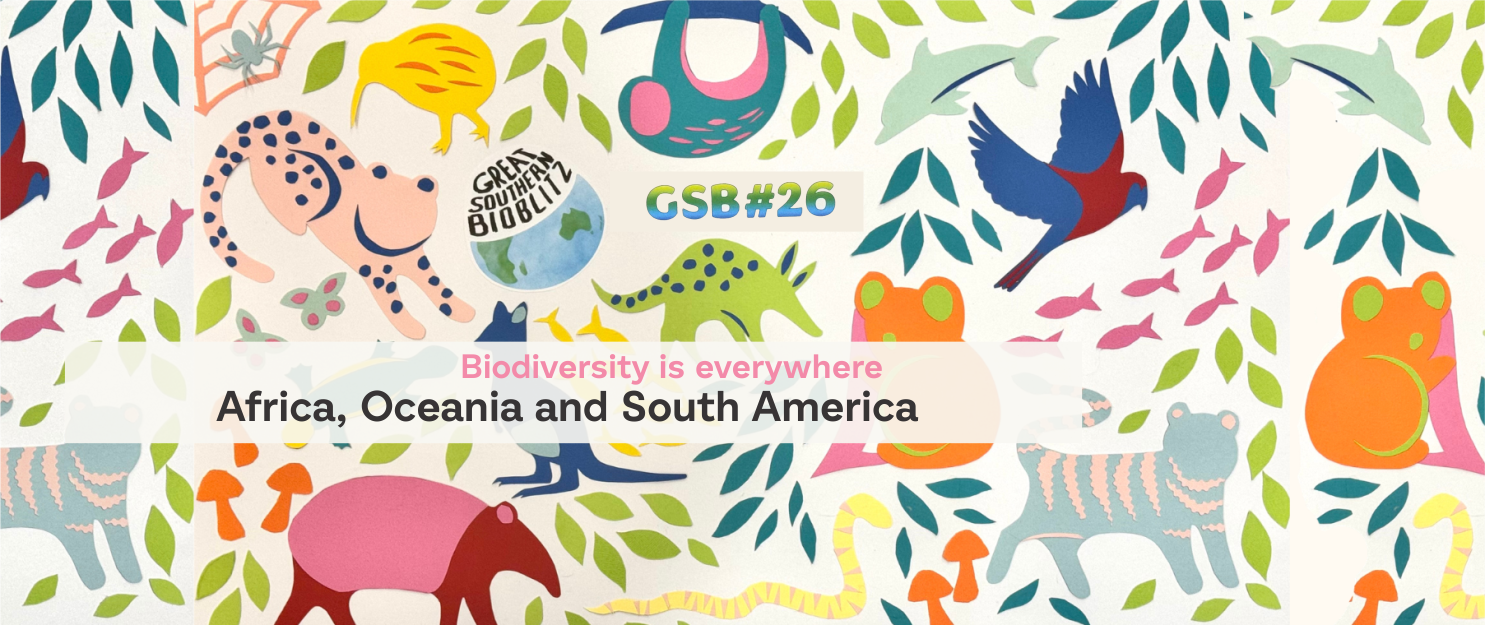
This year’s official GSB banner was created by Claudia Macleay and celebrates the remarkable diversity of life found across the Southern Hemisphere.
Claudia’s hand-cut paper collage brings together birds, insects, fish, reptiles, marsupials and other mammals. Classic mushroom forms represent the fungi, while leaves woven throughout the design represent the plant kingdom.
Describing her design, Claudia said:
“My design is a photograph of my hand-cut paper collage featuring animals from across the Southern Hemisphere. As you look, you will recognise birds, insects, fish, reptiles, marsupials and other mammals. The classic mushroom shapes represent the fungi, while the leaves throughout represent the plant kingdom.”
The banner beautifully captures the breadth of biodiversity celebrated during the GSB and the many forms of life that participants will document in November.
We extend our warm thanks to Claudia for creating this colourful and distinctive visual identity for GSB 2026.
Help us make GSB 2026 our biggest event yet
A huge thank you to the organisers who have already registered projects and begun bringing their communities together. Their local knowledge, enthusiasm and commitment make this international event possible.
Whether you contribute one observation or thousands, every record helps us build a richer picture of life across the Southern Hemisphere.
Save the dates, join your local project and start planning your GSB 2026 adventure.
Observation period: 27–30 November 2026
Upload and identification period ends: 14 December 2026
GSB resources and social channels: https://linktr.ee/gsbioblitz
Comments